Friday, January 16, 2009

In memoriam of Dad, or, grief therapy with Home Depot

So after I wrote the post about being all "meh", I laid down in bed to read and realized that Friday (today) would be/is twelve years since Dad died.  The subconscious is a strange and strong thing.  After spending my November and December working like hell on the office party, then traveling/moving/skiing for a week and a half into January, I haven't really had the chance to rest like I usually do, and January 16th snuck up on me in a way that it usually doesn't.

So anyway, I went to sleep and had a weird dream.  Well, it wasn't that weird.  But it was interesting.

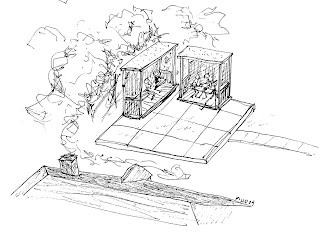
It was a commercial.  Seriously, a commercial.  The camera, as it were, was panning over a town just after a rainstorm.  It becamse apparent from the voiceover and the appearance of the houses that it was New Orleans after Katrina.  That Home Depot music was playing as the camera flew over the little neighborhood.  You know the music from the commercials; if I started humming it right now, you'd know it.  And the voiceover--the same voiceover that does all the Home Depot commercials--was talking about how you can fix things up and build stuff, make your dreams come true.  It panned over a beautiful little grey cottage with white trim and a dark grey roof, and the voiceover said, "You can repair what was damaged..."
And then it panned/flew just beyond the cottage to the lot next door, at which the home had obviously been completely destroyed, and the foundations had been filled in with concrete, scored appropriately, and two little cabana/sheds constructed on it.  The voiceover then said, "...or make new memories when what was is no more."

"...you can do it, we can help."

Then I woke up.


Newt B. Goode: October 5, 1946-January 16, 1997

Thursday, January 15, 2009

Free advice from an architect

First off, I have to welcome Small Town, a new blogger and an architect in the northeast. Thanks for joining us here on the intertubes, man! As a small firm/solo practicioner, you may have some useful info to add to today's post.

If you have any kind of college degree or profession, I bet you get asked for free advice or services. Come on, everyone raise your hand if you’re a doctor, an IT specialist, an aesthetician, a plumber, anything that requires money and an appointment to get done. Same thing with architects—Lawd, we can’t go to a party and say what we do without someone asking us to look at this or that, or how can we add on to the house, or we want to put a deck on back here, or should we do this or that to the house. Usually, Guy and I recommend getting fire insurance and a friend who can work without leaving behind fingerprints or receipts for kerosene and matches. If the person asking keep imploring us for free advice, we tell them our fee, which is what our respective firms charge for our time. That usually shuts them up. However, as architects who constantly absorb and analyze the built world, Guy and I sometimes can’t help but give free advice. When an uncle of mine was building a new house, Guy toured it with some of the family and noticed an opportunity for them to add a small wing wall and a countertop in order to make a bill-paying/mail-catching/phone-locating nook. He told me after the house visit that he felt like he may have been “too” architecty, strolling around telling my uncle how to “improve” his house now that it was over half finished. My uncle ended up taking Guy’s advice, and he raved to us later about how great that little alcove was near the kitchen, how useful, and how he’d never have thought of it himself, and thanks so much for the advice. And that was $80/hour advice at the time, for free.

The world is full of free advice. Every health and fitness magazine has free advice from nutritionists, personal trainers, and doctors, and all it really costs you is the price of the magazine. Every home improvement magazine has tons of advice from builders, interior designers, organizational consultants, and the like. There are countless articles and websites and news features and TV shows with advice from well-renumerated professionals, and while you do have to pay for internet service and cable TV, that cost compared to the cost of hiring all those people to help you personally makes it pretty much free. But advice at any price is useless if it doesn’t really help you, or if it would help you but you don’t take it.

I realize that I have a disclaimer on my blog sidebar that says what you read on this blog shouldn’t be taken as gospel, and I stand by that. But what else am I doing right now of any use? So, as a service to my non-architectural WAD readers, here’s a little free advice from a professional for everyone thinking about adding on or renovating their home:

  1. Purge. Purge, my children. Purge your possessions. Get rid of anything and everything that you could have used in the past year but haven’t. Look at mementos you’ve been holding onto and really think about if you’re still the same person if you were to get rid of it. If you can’t get rid of it, where can you put it so that it can be appreciated and not in the way? Donate clothing that you won’t or can’t wear. Donate books and housewares to Goodwill or other thrift stores. Donate furniture and home accessories to a thrift store or sell them on eBay or Craigslist. Chuck magazines in the recycling. Shred financial documents over seven years old and bills, etc over a year old.
  2. And then scrub. Clean like a mofo. Shampoo the carpets and rugs. Wipe down walls. That’s right, I said wipe down walls, any walls you think someone might even have a chance of having put their hands on. Wipe down baseboards and polish/clean furniture and blinds. Vacuum, sweep, swiff, and mop your floors. Give your bathroom and kitchen fixtures and appliances a good scrubbing. If you can find one of those household steamers, like a Steam Shark, get or borrow it and go to town. Purge and clean. Purge and clean.
  3. When you’re done purging and cleaning, that’s the best time to really assess whether and how much to remodel or add on or whatever. At least one in five people who are thinking about renovating or adding on to their home and who follows steps 1 and 2 will discover that they don’t need to do a damn thing once they’ve gotten rid of some stuff and cleaned what’s left. Well, maybe a few throw pillows, but other than that, they’re done. Also, steps 1 and 2 will show you what you really have to work with and what you have that needs storing or showing off.
  4. Every home improvement project involves three factors: time, money, and energy/motivation. When you consider taking on a home project, especially a DIY project, you need to assess how much of each these things you have. What’s especially important is to recognize of which of these you have the least. Let that be your guide as to what you do in your project. For example, if you have the least of time and only slightly more of money, then you’re going to want to save the extra cash or do some bartering or something to hire someone to do at least some of the work so that whatever time you do have is best spent.
  5. The fourth factor in home improvement is the Universal Law of Handiness. If you’re not very handy, either take a class at Home Depot or somewhere similar or get a handy friend to help. Or again, save up the extra cash and hire someone.
  6. If you’re doing anything beyond wiring a new light fixture into an old light fixture, hire an electrician. Please believe me—it’s worth the cash. If you fuck up a pipe, you’ll send water a-spraying and will need a bunch of towels to clean up, but if you fuck up wiring, you’ll be staring at a pile of cinders where your awesome house used to be and trying to explain to the nice firemen what happened. Do not taunt happy fun electricity.

    There. You’re welcome.

Wednesday, January 14, 2009

The year and a half of my discontent

The alarm went off this morning, and I hit snooze from 5:56 to 6:16am. Really. Why even bother? Well, I work out in the morning, and I just don’t feel normal unless I get up and move a fair amount before my day starts. I laid there for a while, at first barely awake and then mostly awake, and thought about all kinds of things, none of which involved getting up, working out, or work itself. I finally remembered (with help from a “MROWR!” from Maddy) that I needed to get moving so I could start my day on a decent note, so I finally scraped out of bed, changed into my gym clothes, and did some yoga and weights for about 35 or 40 minutes.

Thing is, I’m not historically like this. For most of my life, I’ve never hit the snooze button more than once. That’s right; I’m a morning person. Feel free to hate me. I’m generally the person whose body springs them out of bed at or before sunrise and set me in perpetual motion. Even weirder is that perpetual motion very very rarely needs a nap during the day. But I’ve noticed that ever since my Wheatlands project ended about 18 months ago, it’s taken everything I have to get out of bed and get moving. I’ve usually had things to do, but they weren’t all that major, and they weren’t really mine. I knew that whatever I was doing was temporary—I was not going to be THE architect for MHRC or this or that hospital, the project I was working on was for a few weeks or even less, and so on. I’ve started a fair amount of my days wondering what I’d be doing when I got to my desk, or if my desk would even be mine anymore towards the end of 2008.

It’s been a shiftless, tepid existence. I’ve had to find writing projects to absorb some of the energy being flung off the coils of my hyperdrive—one project I’m doing with Dame Judith, and the other I’m doing for myself. Commenter 2H challenged me to start sharing some of my sketches, which thrilled me until I realized how little I’ve been sketching in the past, well, several years. I used to do a lot more drawing and sketching, but it would seem that the dailiness of architecture has worn me down to just toting a digital camera everywhere, which is no way to be. The way I’ve been living, especially the past three or four years, appears to have worn me down into something less than whole and interesting. Hell, I haven’t posted a Detail of the Week in months, probably over a year.

Funny thing is, I see lots of cool and interesting stuff out there, and then I blow it off. I go home, flip through a Crate & Barrel catalog, and go to bed. I should find stuff that’s interesting and meaningful to talk about and to blog about, lest all seven of my readers abandon me to watch videos of skateboarding dogs on YouTube. Yet when I sit down to write or think about what to say, I feel exhausted. So I feel stuck: I know I need to blog about architecture and educate my peeps, yet I suddenly keep finding myself with nothing interesting to say, or whatever I think of to say exhausts me to even think about writing about.

Anyway. I want to thank everyone for sticking with WAD and me while I ride out the crappy economy and finally find something to do as well as find the energy to drop some knowledge on my playaz out there. I’ll eventually come up with some unsolipsistic tripe to entertain and inspire, or at least not annoy.

Monday, January 12, 2009

When you fail to plan, you're probably asking me to draw something for you

I've been doing some master planning for a medical clinic facility in Denver, but it's unlike any master planning I've ever done.  Usually, master planning for a medical building or a campus involves drawing big, general-looking colored shapes and saying "the clinic goes here and the research facility goes here" or "radiology will go on this floor and admin will go on this floor when the women's clinic moves to this other building over here" and so on.  This master plan, however, is really specific, which is...odd.

First off, the clinic recently had an ADA survey and report done by some consultants who evidently do ADA reports for public buildings.  The report explained what was in compliance (this room works, nicely done), what was kinda in compliance (i.e., flip this door out of the room and you're golden), and what was totally not in compliance (dear God, either remodel this or quit calling it a toilet room).  Second, the facility knows they have some flow and space issues, such as having the wound care exam rooms too far away from the waiting room.  Third, the facility is indeed considering moving certain departments in and out of the clinic building into some other buildings they own.  

Fourth and most importantly, they need someone to help them figure out what moving things around could/would look like so that they can get a contractor to price it and then possibly build it for them.  So, instead of drawing big colored blocks, I'm actually moving rooms around and checking for accessibility clearances around toilet fixtures in the plans.

What's even weirder is that the higher-ups at the clinic's facility planning department don't want us to talk to any of the department's users about these changes.  This is exceptionally unusual--we generally ask the users of a department questions if we're going to remodel it, especially if the remodels are intended to improve clinical flow.  Evidently, the facility managers/directors don't want too much input from the users at this point because a simple what-can-fit-where exercise may turn into a full-blown design project.  Still, it's weird, and it leaves us flying blind.  We're having to guess what rooms can be demolished and what can stay, what offices can turn into exams, and what spaces are too big or too small.  

Usually, we guess wrong.

Friday, January 9, 2009

Some good news for 2009

So, remember that job that I and a few others interviewed for?

We got it.

Thank you Mary, Joseph, and Renzo Piano, we got it.  Turns out we were the first firm to present, and we were not one of five but one of seven to interview for the gig.  Guy's firm was one of the firms that went for it, and for once they didn't get a gig that we both went after.

The job was really to be a series of jobs, as we were interviewing to be their firm for architectural services.  What this means is that anytime the hospital wants to renovate something, tear out a few walls and fix this or that, turn this area into another area, or even add on, they call us.  This is similar to the kind of work Design Associates does at MHRC (go here for the beginning of my MHRC travails).  I believe they're also interviewing contractors to do the intermittent work.

Speaking of MHRC, I got a nice phone call from Squidwort, thanking me for my kind words in my holiday card to him and just saying hi and seeing how I was.  Design Associates, like many companies, sends out holiday cards to clients and consultants, but I like to send some myself to clients I've worked with in the past year. I handmake my greeting cards, and I write something honest, specific, and positive in each one, like how much I appreciate someone's sense of humor, or their dedication to their facility, or their knowledge of a building or whatever.  I also got emails from two other hospital facility managers, thanking me for my card and sending along an FYI about some upcoming work at their facilities.  It would seem that the Personal Pixie Touch makes things happen, no?  Or maybe it's just that the New Year is so full of possibilities.

Wednesday, January 7, 2009

Two Mile High Pixie

Over the New Year's weekend, Guy and I stayed in a condo in Keystone (in the mountains) with a few friends and friends of friends for some ski time.  Thursday we were at Keystone, and then Friday and Saturday we were at Beaver Creek.  Beaver Creek is one or two exits past Vail, and it's shi-shi for sure. You can only drive your car into Beaver Creek if you're staying there.  Whether you own or are renting, it's the priciest ski resort along I-70.  However, because it's a little past Vail, which is 20-30 minutes past Keystone, A-Basin, and Breckenridge, it's also often not as crowded.  And though the housing is way more expensive, the lift tickets are only a bit more expensive that at those three resorts I mentioned, plus with the purchase of a Vail or Beaver Creek lift ticket you can still do night skiing at Keystone.  So, we went to BC on Friday.

When I moved to Colorado from Georgia, everyone asked if I skied.  My response was something like, "Did you not hear the part about me being from Georgia?  No, I don't ski!  When it snows, I go to the grocery store and get bread and milk and then stay home!"  I have many reasons for not skiing or snowboarding, but the main reason is that it just doesn't interest me.  Yes, it looks cool, and yes, I'm sure it's fun.  I'm still just not that enthralled.  Cross-country skiing, however, interested me, so that's what I do.  What this means is that when everyone else hits the slopes, I'm on a sparsely-populated golf course or series of hiking trails near the base or partway up a mountain.  Lift passes for skiing and boarding start at $50 for a buddy pass; my pass is usually around $15 for a whole day in quiet forests and uncrowded parking lot at the nordic skiing center.

However, the cross country park at Beaver Creek is at the top of one of the mountains.  Snowshoers and x-c skiiers have to take a lift up to the park, and our pass costs $24 for the whole day.  Still a good deal, though.  Because you get undisturbed views like this.


That last shot is at the highest point on the x-c course, which is at about 10,200 feet above sea level.  The lowest part of the course is at about 9,810.  Odd--I had been at about 800 feet above sea level in Georgia for the past week, and now here at am many times that high.  Here's how that last shot looked the next day when we went back to Beaver Creek during a storm that dropped about 9 inches total on the park.
Yowza.  It was probably in the teens, and the snow was blowing right into my face, but it was the best day on the slopes--and the cross-country course--by far.   The previous day made for some difficult x-c because the groomed trails were mostly ice.  This layer of soft, powdery snow on the groomed trails made it a hundred times easier to ski in my skinny little cross country skis.  

However, I hadn't done any x-c in about a year, so that plus the icy conditions made every muscle in my body hurt like hell the entire weekend, plus I wore the wrong socks one day and it gave me blisters on both ankles so bad that they bled by the end of Saturday.  And remember how I went from 800 feet above sea level to 10,200 in only a few days?  Yeah, I got altitude sickness.  On Friday and Saturday.  Bleh.  But it was still a great weekend.

Monday, January 5, 2009

While shopping with Mom and Miss Kitty

My sister and I took Mom to Lenox Mall in the northern part of Atlanta while I was home for the holidays.  Generally shopping with Mom is a lot of fun, mostly because her commentary is worth the gas to drive anywhere.  That and she's alos pretty good at being a sounding board for one's potential purchases.  After she helped Kitty and me rationalize purchasing a few pairs of shoes, we took Mom where we knew we'd get the best commentary: Neiman Marcus.

This dress was at the entry of NM.  Kitty and I oohed and aahed over it, astounded at the dress' complexity and awesomeness.  Mom, however, was underwhelmed.  "All they did was sew a circle of fabric in each of the seams and bunch it up a little so it would ruffle.  I could make that."  She cleared her sinuses with the sound of seamstressish finality.  Kitty and I looked at each other--this was about to be a blast.
"Really, Mommy?" Kitty asked.  "You could make that?"
"Not that freaking hard, children," Mom said in the kind of voice in which a mom usually says no I'm not going to carry you.

We went a few steps into Neiman's.  "Mom, you really could make a lot of the stuff in here, no lie," I told her.  "I mean, I asked you to make me that wrap dress like a Diane von Furstenburg."
"Like a Who von Whattenburg?" said Mom.
"Like a that," said Kitty, pointing to our left.

Pixie: Shit fire and save matches! Mom! That patterned dress on the left is a DvF wrap dress just like you made me!"
[Pixie shows Mom the price tag, which says $375.]
Mom: [raises eyebrows] Proud of it, aren't they?

Mom started rifling through the DvF rack, flipping garments over and over to see what they were and how they were made.  Kitty and I kept calling her attention to the price tags.  "Mom, $325, $375, $395.  Seriously, you can make this stuff, charge half what they're charging, and still make bank."  At first, Mom kept giving us The Look, the one where she looks over her glasses at us like we're smoking something usually found in Cheech & Chong's carryon luggage.  But after a while, the look in her eyes was one of possibility.  Or the look of someone about to get away with something.  With Mom, you can never be too sure.
   
She nearly spit when she saw the $1,000+ suits and jackets in the Armani miniboutique.

Mom: Look at this!  Look at this crazy-ass back seam!  All they did was put a fish-shaped piece in the back seam.
Pixie: And they want $495 for that skirt you're holding, Mom.
Mom: [quickly hangs it back up] Shit! At that price, do I have to pay to look?  Were we supposed to pay to be in here?
Kitty:  We'll just tell them we're VIP if they come after us for the cover charge.

Kitty: Ooh, this is cute!
Pixie: Mom, what about this dress?
Mom: [flips up drape at neckline] ...yeah, that's not too difficult.  You have to cut it a little crooked to get it to hang right. [looks around nervously] We have to go.
Pixie: Why?
Mom: Your sister just farted.
Kitty and Pixie: BAAHAHAHAAA!
Mom: C'mon, we gotta go! [shuffles towards the front door]